Books

Nouriel’s writing explores global risks and financial crises, offering incisive analysis of markets, policy, and the future of economies.
+
+

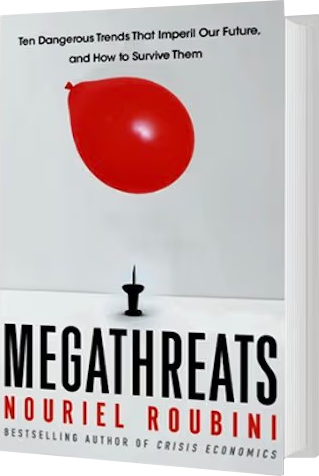
MegaThreats: Ten Dangerous Trends That Imperil Our Future, And How to Survive Them

Renowned economist Nouriel became well known for his prediction of the 2008 housing crisis. Now he is back with a much scarier prediction, one that we ignore at our peril. There are no fewer than ten overlapping, interconnected threats that are so serious, he calls them Megathreats. From the worst debt crisis the world has ever seen, to governments pumping out too much money, to borders that are blocked to workers and to many shipments of goods, to the rise of a new superpower competition between China and the U.S., to climate change that strikes directly at our most populated cities, we are facing not one, not two, but ten causes of disaster. There is a slight chance we can avoid them, if we come to our senses—but we must act now.

“Roubini cuts to the real problems like a hot knife through butter, with a clarity of mind that is rare among economists. I have never seen a more lucid and nuanced account of our financial condition. Not only will the reader be better off after reading this book, but the world will be a better place when central bankers absorb its message.”

Nassim Nicholas Taleb

Author of The Black Swan and Skin in the Game

“No economist is better able to curdle the reader’s blood than Nouriel Roubini. What makes his views significant however is not that they are scary, but that they generally prove to be true. With this book, alas, he has surpassed even his high standards: the ten megathreats the details are as scary as they are plausible. Forewarned is forearmed. Read and pay attention.”

Martin Wolf

Chief Economics Commentator, the Financial Times

“The economist who predicted the 2008 recession is looking around the corner to anticipate the next major crises. Dr. Doom isn’t here to scare you, his goal is to prepare you.”

Adam Grant

Organizational psychologist and bestselling author
+
+

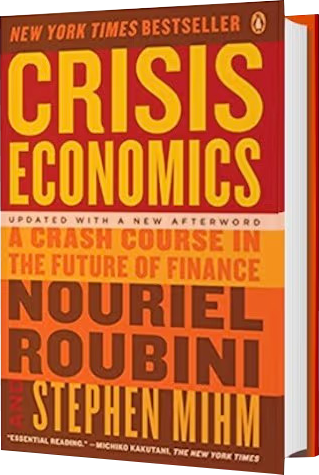
Crisis Economics: A Crash Course in the Future of Finance

Renowned economist Nouriel Roubini electrified the financial community by predicting the 2008 crisis before others in his field saw it coming. This myth-shattering book reveals the methods he used to foretell the current crisis and shows how those methods can help us make sense of the present and prepare for the future. Using an unconventional blend of historical analysis with masterful knowledge of global economics, Nouriel Roubini and Stephen Mihm, a journalist and professor of economic history, present a vital and timeless book that proves calamities to be not only predictable but also preventable and, with the right medicine, curable.

“A succinct, lucid and compelling account of the causes and consequences of the great meltdown of 2008.”
Michiko Kakutani

The New York Times

“A rigorous yet highly readable look at why booms and busts occur and how to keep them from wreaking havoc on the real economy.”

Bloomberg

“An impressive, timely argument on behalf of transparency and stability for a financial system conspicuously lacking both.”

Kirkus Reviews

+
+

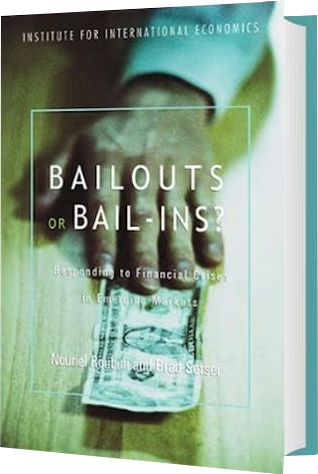
Bailouts or Bail-Ins?: Responding to Financial Crises in Emerging Economies

Roughly once a year, the managing director of the International Monetary Fund, the US treasury secretary and in some cases the finance ministers of other G-7 countries will get a call from the finance minister of a large emerging market economy. The emerging market finance minister will indicate that the country is rapidly running out of foreign reserves, that it has lost access to international capital markets and, perhaps, that is has lost the confidence of its own citizens. Without a rescue loan, it will be forced to devalue its currency and default either on its government debt or on loans to the country’s banks that the government has guaranteed.
“It is by far the best book written in recent years on the vexing subject of how the international community should address international financial crises of emerging market economies.”

Jeffrey D. Sachs,

Director of the Earth Institute, Columbia University

“This is the most intelligent and comprehensive analysis yet of how the international community should respond to financial crises… It will be the definitive work on this subject for some time to come.”

Barry Eichengreen, George C. Pardee and Helen N. Pardee,

Professor of Economics and Political Science, University of California, Berkeley

+
+

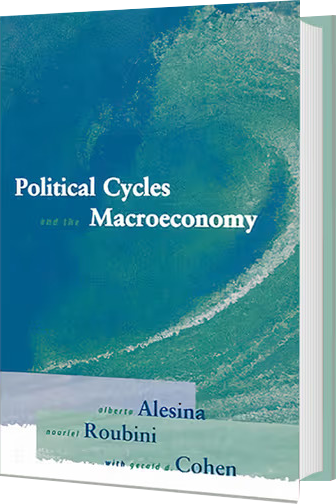
Political Cycles and the Macroeconomy

The relationship between political and economic cycles is one of the most widely studied topics in political economics. This book examines how electoral laws, the timing of elections, the ideological orientation of governments, and the nature of competition between political parties influence unemployment, economic growth, inflation, and monetary and fiscal policy. The book presents both a thorough overview of the theoretical literature and a vast amount of empirical evidence. A common belief is that voters reward incumbents who artificially create favorable conditions before an election, even though the economy may take a turn for the worse immediately thereafter. The authors argue that the dynamics of political cycles are far more complex. In their review of the main theoretical approaches to the issues, they demonstrate the multifaceted relationships between macroeconomic and political policies. They also present a broad range of empirical data, from the United States as well as O.E.C.D. countries. One of their most striking findings is that the United States is not exceptional; the relationships between political and economic cycles are remarkably similar in other democracies, particularly those with two-party systems.
“Alesina and Roubini will surely become the standard reference on how the political process influences the economies of advanced industrial nations. The authors bring politics back into political economy by demonstrating that economic performance does respond to the partisan preferences of the left and the right.”

Howard Rosenthal, Roger Williams Straus,

Professor of Social Sciences, Professor of Politics, Princeton University

“Written by two leaders in one of the ‘hottest’ fields in economics, this book clearly and convincingly explains how partisan differences, re-election motives, budgetary procedures, and central bank charters may shape monetary and fiscal policy. Alesina and Roubini provide a lucid survey of existing theory; but first and foremost the integrate and extend existing empirical evidence on political cycles, policies, and macroeconomic outcomes in the postwar industrial democracies. Their book is destined to become a standard reference, both for students and for researchers in the field”

Torsten Persson,

Professor of Economics, Stockholm University

“A fundamental contribution that marks a huge step forward in our understanding of political business cycles. This book is a remarkable achievement: it combines the rigor of economic theory, the originality of a comprehensive empirical analysis, a rich new data set, and a marvelous clarity of exposition. It should be on the shelves of anyone interested in political economics.”

Guido Tabellini,

Professor of Economics, Bocconi University